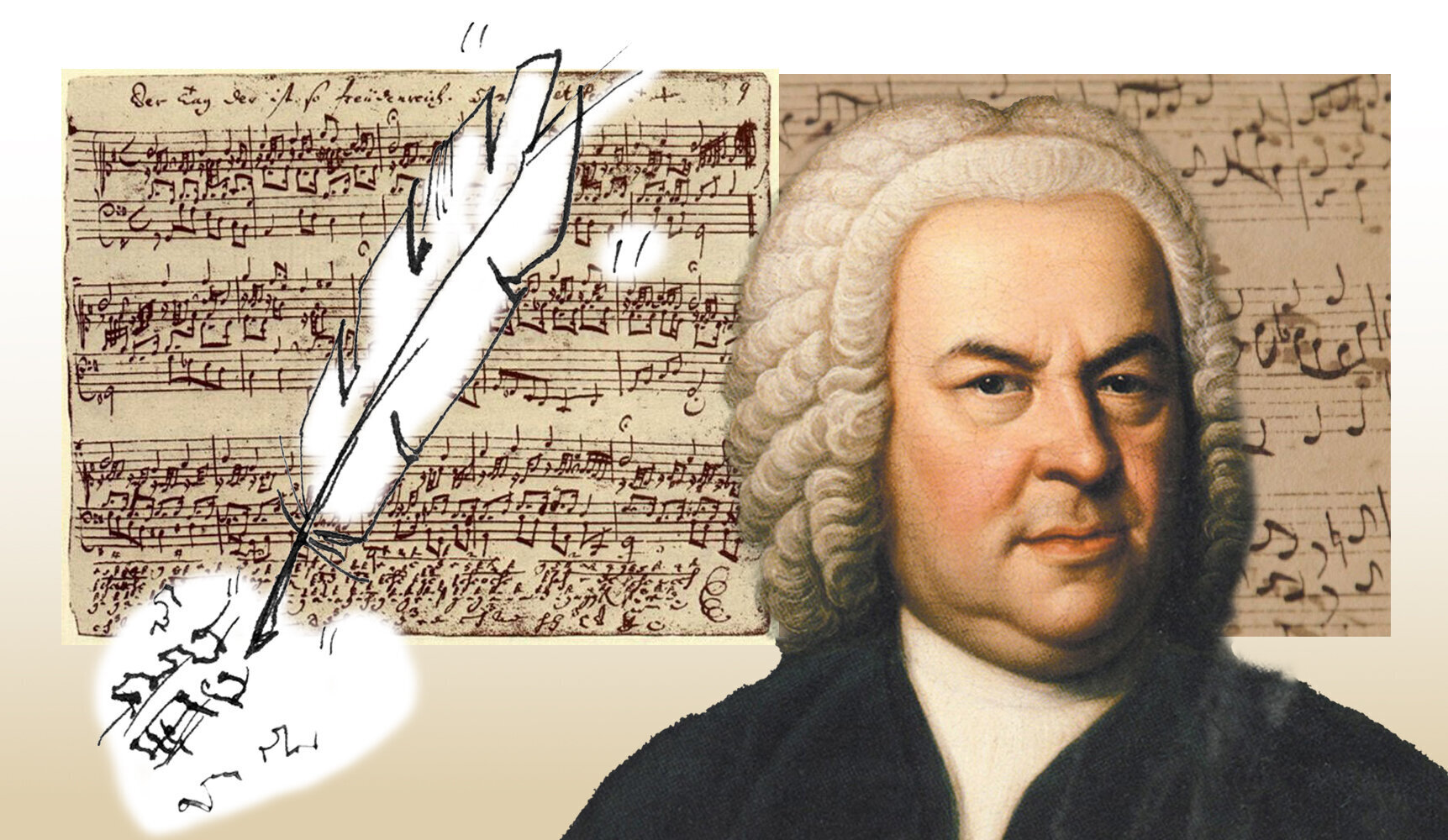
Imagine: it’s the beginning of the 18th century, and Johann Sebastian Bach is a young musician working his way up. He’s a bit impetuous and sometimes gets into trouble. At Arnstadt, he asks for a four week leave to visit the North German composer Buxtehude, then makes the 280-mile journey on foot, and stays for four months. His employer is not happy. At his next job, he gets mixed up in court politics and thinks it better to leave.
None of this slows the flow of music. I see him, quill pen clutched in hand, bent over a score lit by candlelight, or near a small window in wavering winter sunlight filtered through thick panes of glass. As a court composer, Bach’s job was to write a new cantata every week.
Just think of creating this complex music on schedule – choruses, solo sections, closing chorale – then preparing the singers for Sunday service. As the years went on, he fathered 20 (yes, 20) children. Perhaps they helped by copying parts, learning music as they worked. Johann himself had grown up doing this task for his elder brother, a professional organist.
We know that Bach studied the music of his German contemporaries as well as French and Italian composers, all while composing and teaching. He collected a huge library of manuscripts of their work. Clearly, Bach was a man of wide learning and intellectual vitality. Sadly, he left this earth at the age of 65, after unsuccessful surgery to improve his failing sight.
We are fortunate to have many works by Bach, but music historians estimate that they may be only about half of what he wrote. For example, of five Passions, only two, the St. Matthew, and the St. John, survive. We have 200 cantatas, but another hundred are lost. Still, we can marvel at the intellectual and emotional brilliance, and the sheer variety, of Bach’s legacy.
He wrote for a variety of instruments and in many different forms. To mention just a few: the famous Toccata and Fugue in D Minor for organ; the Brandenburg Concertos for orchestra; the partitas and sonatas for solo violin; the solo sonatas for cello; the Well-Tempered Clavier and The Goldberg Variations for keyboards; and choral works such as the great B Minor Mass. There’s even a charming secular “Coffee Cantata.” (Hmmm, did this genius get a little caffeine boost from time to time?)
We will never know how he managed to do it, but, more than 250 years later, we still have the music of Johann Sebastian Bach to inspire and delight. We invite you to join the Santa Cruz Chorale, guest soloists, and the Monterey Bay Sinfonietta as we sing four of Bach’s cantatas of faith and hope, in Why the World Loves Bach.
Mary Crawford, alto